
ScrubLog
Turn server access logs into practical technical SEO evidence
ScrubLog is a free, private server log file viewer for technical SEO specialists and web developers. Import an access log and turn individual requests into readable trends, response hotspots, URL patterns and claimed crawler activity.
The dashboard combines high-level charts with detailed tables and filters, so you can move from a traffic pattern to the exact requests behind it. It supports common CSV and text exports alongside Apache, Nginx, IIS/W3C, JSON and NDJSON formats.
Log contents are processed inside the browser and are not uploaded to Scrubnet. Saved files, filters and views remain in local browser storage, letting you return to an investigation without creating an account or cloud project.
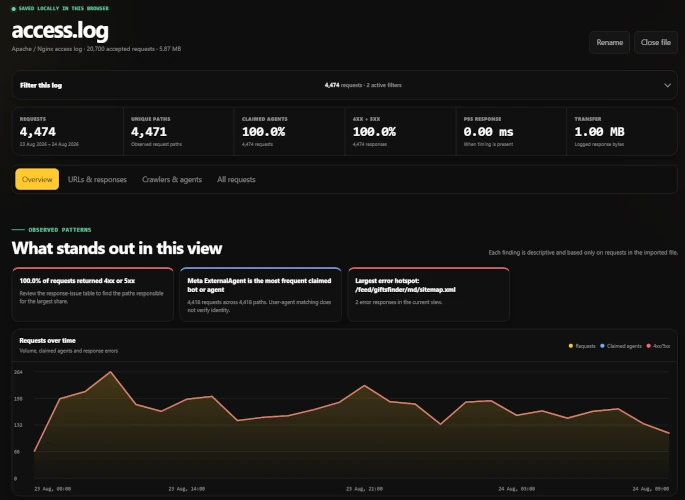
See what is requesting your site
Server logs show the requests that reached your infrastructure. ScrubLog organises those observations into a practical investigation workspace without turning crawler access into claims about indexing, ranking, citation or business value.
Import common server log formats
Start with the format you already have rather than rebuilding an export for the tool.
- Read CSV, TSV and other common delimited files
- Parse Apache and Nginx common or combined access logs
- Recognise IIS/W3C field declarations and UTC timestamps
- Read JSON arrays and newline-delimited JSON records
- Map common timestamp, URL, response, agent and timing fields automatically
- Report skipped rows, unmapped fields and inferred timing units
Understand request activity
Use complementary charts to see volume, timing and response patterns in the current filtered view.
- Follow total requests, claimed agents and errors over time
- Compare HTTP response classes and response-time bands
- Review request concentration by weekday and hour
- Measure unique paths, error rate, p95 response time and transferred bytes
- Surface descriptive findings based only on the imported requests
Find URL and response hotspots
Group individual requests into the paths and directories that need investigation.
- Rank the most requested paths and top-level directories
- Find paths returning repeated 4xx or 5xx responses
- Identify frequently requested redirecting paths
- Compare p95 and median response times by path
- Count observed query-string variants without merging their source rows
- Keep last-seen times and status mixes close to each issue
Compare claimed crawlers and agents
Organise user-agent text into useful families while keeping the interpretation boundary explicit.
- Group search, AI, SEO, monitoring and social-preview agents
- Filter by claimed family or agent category
- Compare requests, unique paths, response errors and last-seen times
- Retain source user-agent strings for detailed inspection
- Label matches as claimed because user-agent text can be spoofed
- Perform no DNS, IP-range or remote identity checks
Filter, inspect and export
Narrow a large request set without losing the source records behind the analysis.
- Filter by date, timezone, path, query string, status and method
- Search user-agents, client IPs, referrers and hostnames
- Set response-time and response-byte ranges
- Use quick filters for agent errors, redirects, 5xx responses and slow requests
- Sort and paginate the matching request table
- Mask client IPs on screen and in filtered CSV exports
Continue locally where you left off
Keep multiple investigations available in the same browser without creating a remote workspace.
- Save imported datasets in browser-local IndexedDB storage
- Restore the last opened file automatically
- Retain filters, active tab, sorting, pagination and IP masking per file
- Rename, reopen or delete historical imports
- Review estimated site-storage usage and browser persistence status
- Clear all locally stored ScrubLog data in one action
Private analysis with a clear scope
ScrubLog is designed for focused access-log investigations in a modern browser. It analyses what is present in the imported file; it does not connect to your server, verify crawler identity remotely or infer outcomes that the log cannot demonstrate.
- No account or network upload inside the ScrubLog app
- No analytics or third-party scripts inside the analysis app
- Files and saved views stay in the current browser profile
- Storage may be removed through browser settings or eviction
- Imports are limited to 20 MB and the first 100,000 requests
- Larger logs can be divided into focused date ranges before import
- Claimed-agent labels describe user-agent text, not verified identity
- Automatic mappings are disclosed through import notes
Feedback and issue reporting
If you have feedback, a server format you would like ScrubLog to support, or an issue to report, email contact@scrubnet.org.
Turn your server log into an investigation
Import a log, isolate the requests that matter and explore response, timing, URL and automated-agent patterns without sending the file away.