
You update a guide today. A crawler may still have yesterday’s copy. Freshness signals help readers and bots tell when content changed and check whether a copy they already have is still current.
Published
Where do freshness signals appear?
Imagine a guide published on 14 September 2026 and substantially revised on 6 October 2026.
XML sitemap
An XML sitemap lists page URLs. The <lastmod> value gives the date of a particular page’s last significant update. Use the date the guide actually changed, even if you regenerate the sitemap later. Google says it uses this value when it is consistently accurate and verifiable. Google’s sitemap guidance
<url>
  <loc>https://example.com/guide</loc>
  <lastmod>2026-10-06</lastmod>
</url>
Visible dates and structured data
A reader might see Published 14 September 2026 and Updated 6 October 2026. JSON-LD can carry those same dates as datePublished and dateModified. Google considers page dates alongside other clues when deciding which date to show in search results. Google’s guidance on page dates
{
  "@context": "https://schema.org",
  "@type": "Article",
  "datePublished": "2026-09-14",
  "dateModified": "2026-10-06"
}
HTTP response headers
Last-Modified gives the server’s modification date for the version it serves. ETag gives that version a tag. A crawler can send back the date in If-Modified-Since or the tag in If-None-Match to check its saved copy. Google’s crawler caching documentation
Last-Modified: Tue, 06 Oct 2026 10:00:00 GMT
ETag: "guide-v2"
How might bots use them?
A crawler might use a sitemap date to decide which pages to revisit sooner. If a bot sends a conditional request and its saved copy is still current, the server can return 304 Not Modified without sending the page body again. The bot still makes a request, but there is less data to transfer. HTTP specification
What do we still not know?
For many bots, we still don’t know which signals they use, if any, or how much those signals affect when they come back. Server logs can show when a verified bot visited and what the server returned. Establishing why it chose that URL, or whether the page was later indexed or cited, takes separate evidence.
Scrubnet’s first Freshness Observatory results offer an example of what crawler request logs can reveal. Freshness Signals vs Crawl Reality
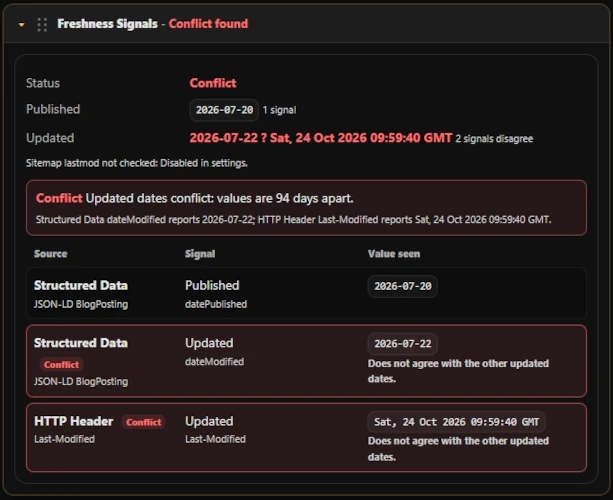
How to check freshness signals with SEO Scrubbox
- Open the page in Chrome and click SEO Scrubbox. Under Freshness Signals, look for the page dates and the
Last-Modifiedheader found by the quick check. - In Cache & Compression, the Validator row shows whether the audit found an
ETag. - Select Run Deep Checks. If the audit finds a
<lastmod>value for that URL in a checked sitemap, it appears under Freshness Signals.
Get the extension from the SEO Scrubbox page.